


.jpg)

.png)





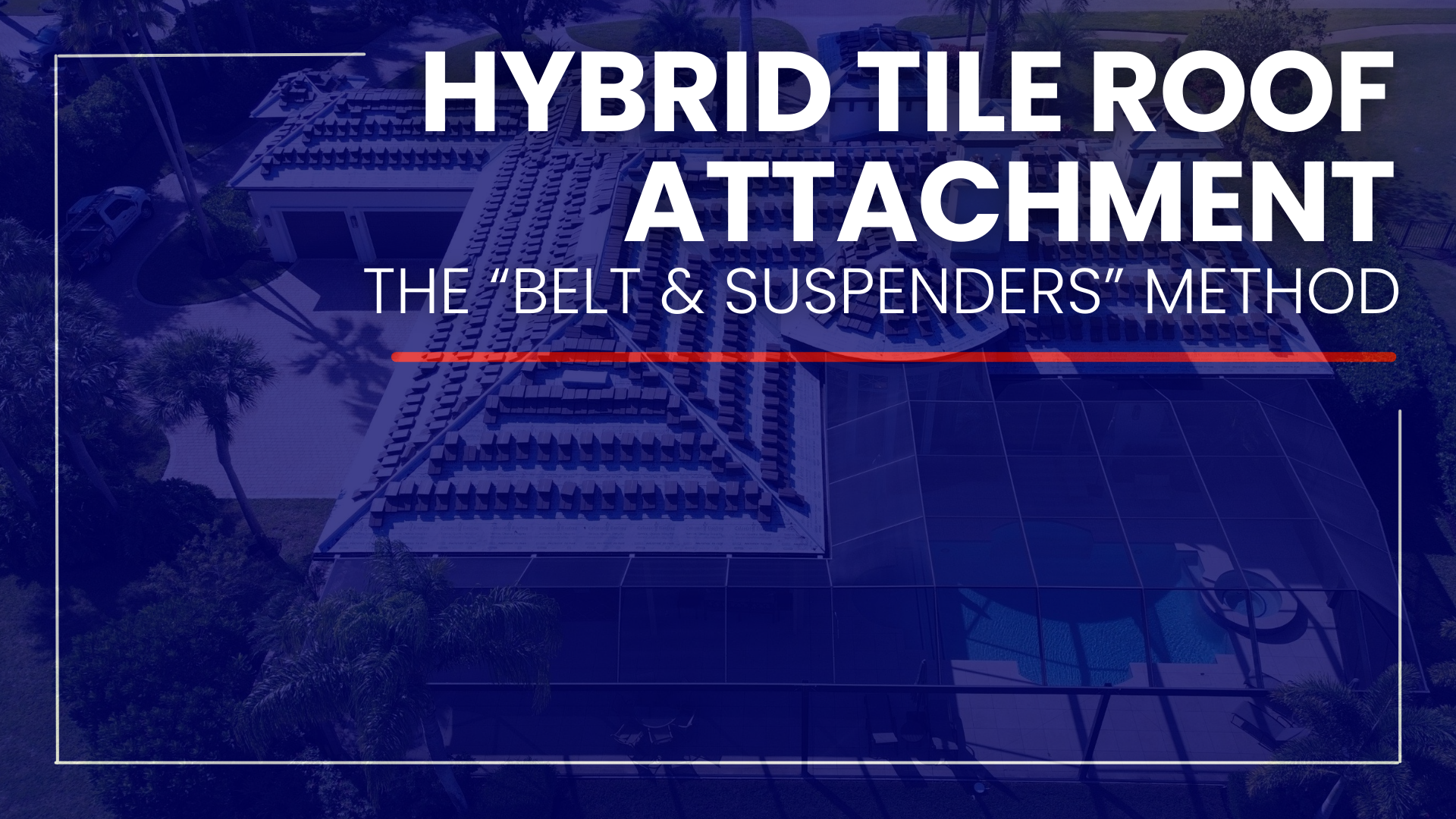
This method is often selected in residential or condominium roof replacement in Southwest Florida when budgets do not allow for two part foam.
Hybrid tile attachment combines mechanical fasteners and foam adhesive to improve the stability of the tile roof system while balancing performance and cost.
Understanding how this system works can help property owners make informed decisions about roof replacements and storm preparedness.
How Hybrid Tile Roof Attachment Works
A hybrid tile attachment system uses two separate attachment points for each tile.
First, a mechanical fastener, usually a screw, secures the tile near the top where it overlaps with the tile above it. This fastener anchors the tile to the roof deck.
Second, a foam adhesive pad is applied underneath the lower portion of the tile. The foam bonds the tile to the underlayment and helps stabilize it across a larger surface area. When combined, the method offers more secure attachment than one-part foam or mechanical fasteners alone.
The mechanical fastener provides a fixed anchor point, while the foam adhesive helps reduce movement and vibration across the tile surface.
Because both systems are working together, many roofing professionals view hybrid attachment as an added layer of protection. While two-part foam is the strongest method, hybrid is a good compromise in storm-prone areas for budgets that do not allow for two-part foam.
Why Tile Movement Matters During Storms
Tile roofs are designed to allow a small amount of movement. This flexibility helps the tiles accommodate expansion and contraction caused by temperature changes.
During strong wind events, however, this movement can increase significantly.
As wind passes over a roof, it creates uplift pressure on the tiles. If the tiles are not firmly secured, they can begin to vibrate or shift slightly. This movement is commonly called tile chatter.
Repeated movement can weaken fasteners, stress adhesive bonds, and cause uplift near tile edges. Once wind gets under a tile, it can easily slide out of place. This is one of the most common reasons tiles are lost during hurricanes.
Hybrid attachment helps reduce this movement by providing both a mechanical anchor and an adhesive bond. The result is a more stable roof tiles during high wind conditions.
Why Roofers Call It the “Belt and Suspenders” Method
The phrase “belt and suspenders” comes from clothing. Both a belt and suspenders hold up a pair of pants. Using both at the same time provides extra security.
The same idea applies to tile roof attachment.
A tile secured only with a mechanical fastener can still move around that single attachment point. A tile secured only with foam relies entirely on the adhesive bond.
Hybrid attachment provides two layers of protection.
The mechanical fastener secures the tile to the structure of the roof, while the foam adhesive helps distribute wind forces across the tile and reduces movement.
This redundancy is one reason hybrid systems are often recommended in hurricane-prone areas.
When Hybrid Tile Attachment Makes Sense
Hybrid attachment is often used when property owners want improved tile stability without installing a full foam system across the entire roof.
It can provide many of the movement-reducing benefits of foam while using less adhesive material, which may help balance cost and performance.
For many condominium communities and residential roof replacement projects in Florida, hybrid attachment offers a practical middle ground between traditional mechanical fastening and full foam systems.
When evaluating a tile roof replacement, it is important to discuss attachment options with a qualified roofing contractor. The attachment method used can significantly influence how the roof performs during severe weather and how well it protects the building over time.

.png)